Zoology & Taxonomy
Ah, science. Of all subjects it was my weakest in high school: chemistry specifically. I did alright in biology, mostly because my best friend and I were in the same class and studies together. If you listened closely during tests and exams you might have heard us humming softly. We found that the best way to remember the facts was to make up silly songs. If only I had begun learning science the Montessori way! Here is a sample lesson, one that can be repeated indefinitely without growing tedious.

Above you can see the (almost) completed lesson in zoology/taxonomy. I use it as a launching board to talk about all different kinds of plants and animals, but mostly animals. We begin with the most basic of categories: living and non-living. Ella sets out two pieces of paper, one labeled "Living" and one labeled "Non-Living."

I've made up many cards (just using Microsoft Word, eight cards to an 8 1/2 x 11 page), the vast majority of them animals, for Ella to sort. I've mixed them all up and divided them into small groups so she can grab a pile and sort through those that day.

Choosing items for non-living was very interesting. Most things I chose were no-brainers, i.e. they are obviously non-living, but there were a few that were more challenging. Fire is an excellent one as it has many characteristics of living things (can grow, can move, needs air, needs "food", leaves waste, etc.) and there are a few others that can catch one unawares. Above you can see that included in this pile are lightening, stalactites, rocks, and a compact disc. There was no doubt that the rocks and compact disc were non-living, but lightening has some similarities to living things as do stalactites. It took quite a while for her to decide where to put the stalactites because in an earlier stack she had coral, which appears to be like a rock, but is actually living. The sneaky ones are the most fun and they help reinforce the difference between the living and non-living.

I scoured the internet for the pictures I used for each card. While I tried to focus on variety, keeping in mind that the majority of cards would have to be vertebrates, I did make an effort to put in plenty of animals that are native to our area, such as the ruffed grouse (bottom left), which is a popular game bird in New Brunswick.
After separating living from non-living we take our pile of living and divide them up between "Plants" and "Animals." Yes, I know that there are more categories of living things than just those two, but as they are the most common and encompass almost every living thing with which a child is familiar we focus on them. Fungus, protozoa, bacterium, etc. can come later.

Most of this sorting Ella found very easy, but I tried to keep her on her toes. The Venus flytrap, being carnivorous, gave her a moment's pause. And she was convinced for a long time that coral must be a plant, which I grant you, is not an illogical conclusion!

This particular pile of cards only had three samples of plants. Our discussion of the tree trunk was interesting as the tree itself was dead, and therefore neither living or non-living, but it was covered in moss (which was my target species) and the moss was clearly alive. Ella decided that rather than having just two initial categories there should be three: living, non-living, and formerly-living/dead. After all, wood was once a tree, and the radishes can't really be living if they've been pulled up out of the ground, chopped up, and pickled! Smart girl.

After the plant/animal division, we take the animal cards and divide them between vertebrates and invertebrates.

Categorizing animals this way is a bit more challenging. Because you can't actually see the backbone or spine in a vertebrate you have to think through how an animal moves, how it lives, and what its surface feels like. Ella is just beginning to remember consistently to look for segmentation of the animals' bodies, hard exteriors such as shells (an exoskeleton), and over-all "smooshiness" (that the body is completely smooshy or soft, indicating that there are no bones).

Again, putting in tricky cards gives the opportunity to discuss the "why is it this one and not that one?" question. Above I included a sea horse. Ella concluded initially that it was an invertebrate because it appears to have an exoskeleton, even though it is a fish, though like catfish sea horses do not have scales.

Following the organization of the vertebrates and invertebrates we take the pile of vertebrates and then comes the real sorting fun!

With five categories to chose from there's a lot more room for error. Each animal has to be evaluated in several different ways: what kind of "skin" it has and/or if it has a skin covering (hair, fur, feathers), whether it gives birth to babies or lays eggs, if it lays eggs whether it lays them on land or in water, if the offspring look like miniatures of the parents or if they have another form entirely, if it has a mouth or a beak/bill, how it breathes, where it lives, if it is warm or cold blooded, and how it feeds its babies. There are hosts of conversations to be had as we work through these cards, and I frequently find that Ella and I end up laughing, especially at odd animal behaviour or appearance.

Amphibians. They have slimy skin, live in or near water, are cold-blooded, lay eggs in water, have babies that look nothing like themselves and whom they completely ignore, and usually can breathe right through their skin. Their appearances have little variation: frogs and toads look similar as do salamanders and newts. To give a bit more variety I've tried to include pictures of amphibians at various stages of development.

Mammals.* We are warm-blooded, have fur or hair, live all over, breathe air with lungs, give birth to babies that look similar to the parents (usually!), and feed our offspring with milk from our own bodies. Isn't it great to be a mammal? There are quite a few unusual mammals, like whales, manatees, platypuses, etc. It can be fun to emphasize the similarities between humans and other mammals, as well as the differences. Thank God for opposable thumbs! Plus, as a nursing Mum, it's interesting to discuss how other species nurse. In the case of whales, Ella would not believe me that they were mammals until I found a video of a beluga whale giving birth and nursing her baby!

Fish. They live in water, are cold-blooded, and breathe through gills. Some species give birth to live young, but most lay eggs. The level of parental involvement is usually low to nonexistent. Although there are three different classes of fish, for the young child and early elementary student so many details can be confusing, so I lumped all the fish together. When (or if) I ever have time to set up an aquarium again we will certainly get into closer examination of fish classes.

Birds. Feathers, beaks, wings, and two legs are the most easily recognizable traits. They are warm-blooded, breathe air with their lungs, lay eggs, and are frequently attentive parents. One of their families (the penguins) are even able to survive in the harshest climate on earth and one of their species (emperor penguins) stay in that climate during its harshest season in order to go to extraordinary lengths for the purposes of mating, bearing, and raising offspring. In my opinion, birds are way cool!
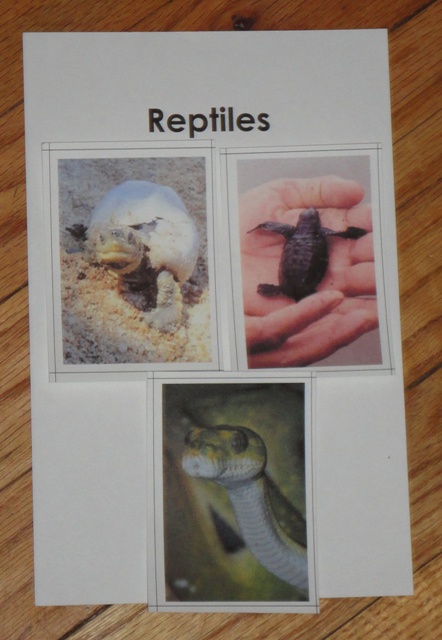
Reptiles. Some like life where it's hot and dry and others would prefer to stay wet all day long. But they all have scales, breathe with their lungs, are cold-blooded, lay eggs on land, and their babies look like miniature adults. They are also very good for frightening grandmothers and mothers when brought in from outside with a cheerful, "Look what I found, Mum!" (Please note: this refers to something my brother did to my mother and grandmother, not something my children did to me. I would not be so chicken-hearted... I hope!)

After all the sorting has been done, we clip each section together with other cards of the same category, to play with and discuss later.

Eli added his own artistic touch to the non-living card!

And, as is so often the case with homeschooling Montessori Mums, how to store materials effeciently is of great concern, so here's what I did. I found this tray and this box at the local Dollarama store.

The tray perfectly fits half of an 8 1/2 x 11 piece of paper (or cardstock), which is what I used for the category titles, and the small crate is perfect as a card holder!

*Please note: While all the photographs taken above were mine, the pictures in the photographs are not. They were all found online through Google search. The human family in the mammals is unknown to me, but it was the best photo I could find of nude humans that was neither graphic (in the negative sense) nor of poor quality. Since all the other animals were au naturel, I figured it was only fair that the humans were as well. For the record, I think it is a beautiful and tasteful photo... though I don't think I'd be comfortable with my family posing in such a manner, or at least displaying it!
Labels: animals, biology, DIY, do it yourself, homeschool, lesson plans, Montessori, science, sex education, sorting task, zoology
posted by HomeSchooler @ 9:35 p.m.
5 Comments


